0

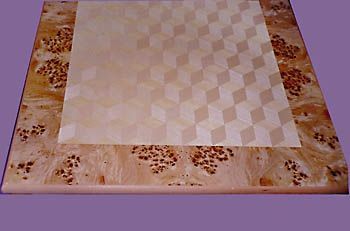
Louis cube parquetry tables in a variety of timber specie options, COMMISSION ONLY

£0.00
Sold out
Price incl. VAT (20%) £0.00
Sold out
Product Details

Louis cube parquetry tables in a variety of timber specie options with solid timber or veneer lipping, COMMISSION ONLY, You can choose timber specie for the border from the specie library at the bottom of the front page of the shop. Talk to us about leg design. Talk to us about the louis cube style species. Additional photos show just a few of the myriad of options available

Dimensions: made to measure but generally 565x565x490mm high

Restored: n/a, new and unused

Origin: Devon, UK, 2025 onwards

Extras(please contact the office): satin or matt respray and polish with hardwearing uv and oxidising resistant lacquer to help preserve colours

Our master craftsman has been an adventurous exponent of radial harlequin, micro mosaic(syn. Tunbridge ware and Sorrento ware) and Louis cubes/isometric cubes (syn. tumbling blocks) parquetry for over 35 yrs.

His imaginative re-engineering of these parquetry techniques makes a marked difference from other modern day advocates/revivalists, the original Tunbridge/Sorrento ware makers and parquetarians of the16th and 17th century(when radial harlequin and Louis cube gained popularity in France, respectively), with the following traits:
1. Many of his designs tend to push the limitations of historical work in the same vein..in quality, colour, form and concept. We believe, some are the first of their kind eg. radial Louis cube(being worked on now) and his signature name plate in micro mosaic curvy script. If we are wrong about that, we certainly can't see these types of work in commercial production anywhere. His work tends to be executed with more meticulous craftsmanship. Zero tolerance laying/abutting of veneer/tesserae is the norm. No filler paste/wax is used at all in his work.
2. No pearl glue is used as it was with Tunbridge ware and earlier veneering. Pearl glue, despite having a few good attributes for other techniques in woodworking, has a poor longevity of adhesion in service. It is prone to loosing adhesion with moisture and heat and time, thus causing veneers/tesserae to lift /become detached. We generally, only use water based resin glue that has huge adhesion integrity, is water proof and unaffected by heat and uv light.
3. Substrates we use are rarely solid timber(unless of very thin section size or very stable species). Solid timber is prone to more movement than plywood or mdf. Solid timber substrates for veneering of any kind are prone to much more movement/warpage/splitting, all of which will eventually affect the quality in service of the finished veneering.
4. French polish is rarely used, and mostly reserved for antique restoration where colour has already been lost or where touch up/part polishing is all that's required. French polish is an inferior product to the modern day water proof pu acrylic lacquers with ultra violet light inhibitors and prevention from oxidisation. Both these traits remove the fresh cut naturally vibrant depth of colour of timber and veneer, which can rarely be brought back...which is why most wooden antiques look tired and faded or darkened(some timber colours darken over time, some become faded or 'bleached'). Our lacquers are intended to preserve colours for hundreds of years. French polish can't do that and is a very soft, non-durable and not scratch resistant finish.
In short, we believe people who stubbornly advocate antiquated materials are in effect selling you an inferior product. With veneer gluing and finish polish, there is no merit in quaint nostalgia of 'time honoured' yet inferior materials...contrary to what many box makers, restorers, antique dealers and alleged 'experts' will sell you a narrative of.
Innovation and evolution of practice is more preferable
We believe in making and selling the best that is practically achievable
Share this product with your friends
Louis cube parquetry tables in a variety of timber specie options, COMMISSION ONLY